Turning a loose mass of fibers into a stable, shaped product usually requires some form of bonding. In many nonwoven and wadding applications, that bonding is achieved not with an external adhesive, but with a specially engineered fiber that acts as its own glue. This is the role of low melt fiber — a functional fiber type that enables binder-free bonding across a wide range of thermal and cushioning products.
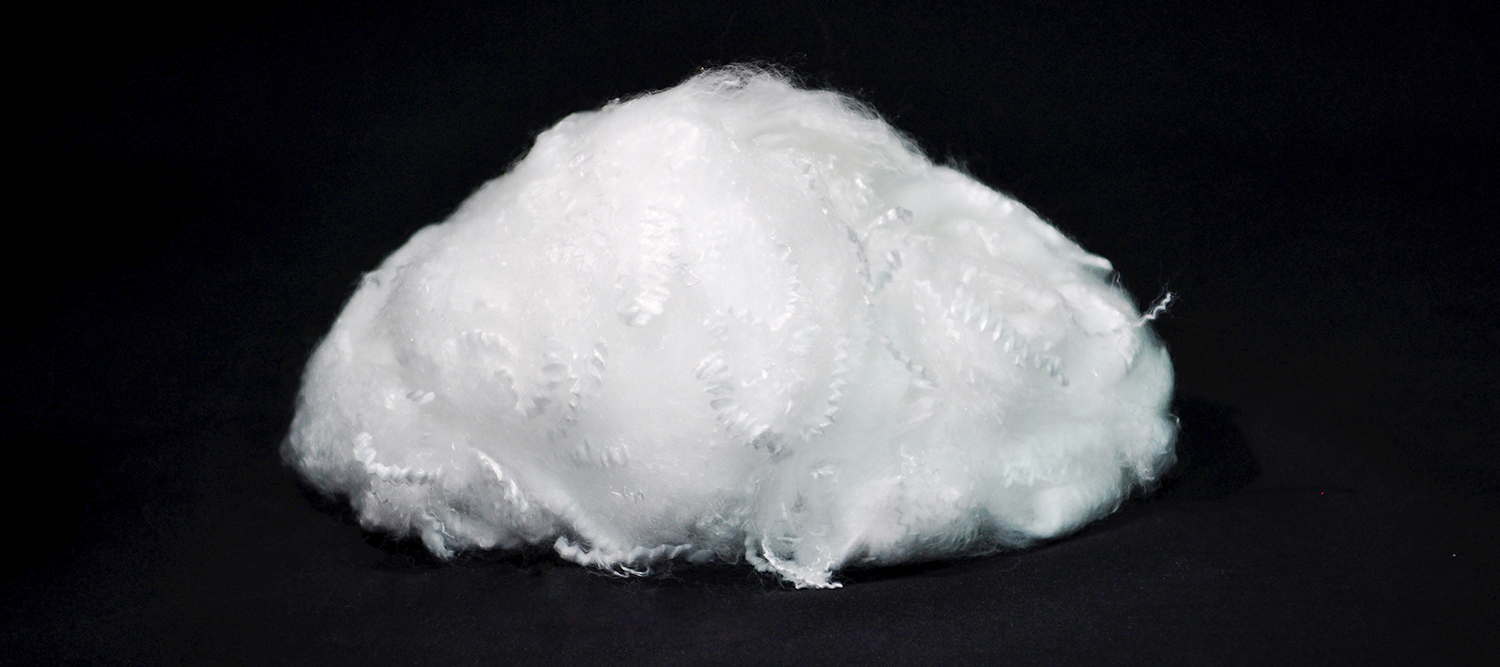
Low melt fiber is a bicomponent fiber, meaning it is made from two different polymer components combined within a single filament, typically in a sheath-core configuration. The core is usually a conventional polyester (PET), chosen for its higher melting point and mechanical strength. The sheath, or outer layer, is a specially formulated co-polyester engineered to melt at a significantly lower temperature — often 80 to 100°C below that of standard PET.
This structural design gives the fiber two functions in one filament: the core provides structural support and helps the fiber maintain its shape and strength, while the sheath is designed specifically to melt and flow under controlled heat. Depending on the formulation, the sheath typically melts somewhere in the range of 110°C to 150°C, well below the melting point of the core and of most other fibers it is blended with.
The bonding process begins by blending low melt fiber with other fibers — commonly regular polyester staple fiber, cotton, or other synthetic fibers — to form a loose web or batt. This blended material is then passed through a heat-setting process, typically using a hot air oven or a heated calendering system.
The processing temperature is carefully controlled to sit above the melting point of the low melt sheath but below the melting point of the fiber core and the surrounding blend fibers. As the material passes through the heat zone, the sheath layer softens and begins to flow at the points where fibers cross and touch one another, while the core and other fibers in the blend remain solid and retain their original shape.
As the material moves into the cooling stage, the melted sheath resolidifies, forming a network of fixed bonding points throughout the fiber structure. These bonding points lock the fibers together at their intersections, creating a coherent, dimensionally stable structure without the fibers ever fully melting or losing their individual identity. Because bonding happens only at the sheath layer, the fiber core continues to provide loft, resilience, and mechanical strength even after the material has been thermally set.
This mechanism is what allows low melt fiber to function as a built-in binder: no external adhesive, resin, or spray is needed, since the bonding agent is already part of the fiber itself.
This bonding approach offers several practical advantages over traditional adhesive-based bonding methods.
No added adhesives. Because bonding is achieved through the fiber's own low melt sheath, there is no need for external glue or resin systems, which reduces VOC emissions and simplifies compliance with regulations covering products such as children's goods and bedding.
Retained softness and loft. Unlike spray-adhesive bonding, which can stiffen a material or cause localized clumping, thermal bonding through low melt fiber tends to preserve a softer handle and more even loft throughout the structure.
Simplified processing. Since bonding and shaping happen in a single heat-setting step, manufacturers can streamline production compared with processes that require a separate adhesive application and curing stage.
Adjustable firmness. The proportion of low melt fiber blended into the fiber mix — typically in the range of 10% to 30% — can be adjusted to control the firmness, density, and bonding strength of the final product, giving manufacturers flexibility to fine-tune performance for different applications.
Low melt fiber's self-bonding capability makes it well suited to a range of thermal and structural applications.
Thermal wadding. Insulating layers used in jackets and outerwear rely on low melt fiber to hold their shape and loft after repeated washing and compression.
Automotive interior materials. Sound-absorbing and thermal insulation panels used in vehicle interiors often use low melt fiber blends to achieve dimensional stability without added adhesives.
Mattress and furniture padding. Shaped support and cushioning layers in mattresses and upholstered furniture use low melt fiber to create firm, consistent structural layers that retain their form over time.
By combining structural support and bonding function in a single fiber, low melt fiber offers a simpler, more consistent way to shape and stabilize fiber-based products — making it a practical choice wherever adhesive-free bonding is a priority.
If you need help selecting the right low melt fiber blend ratio for your application, our technical team is available to provide guidance based on your product requirements.